
By Ferdinand Olise
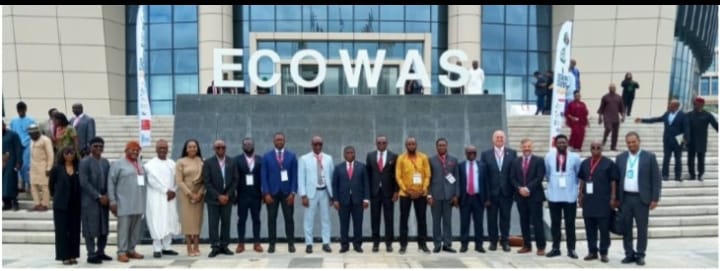
The Economic Community of West African States, ECOWAS, has commenced its Startup Awards programme designed to connect promising businesses with investment, markets and opportunities to scale across the region.
Speaking in Abuja at the Second ECOWAS Startup Awards, the Acting Director of Private Sector and Industry at the ECOWAS Commission, Mr. Peter Oluonye, said the initiative was structured to address key challenges facing start-ups, particularly access to finance, markets, technology and growth opportunities.
The selected businesses included various sectors including agri-tech, food and health technology, agriculture, clean and climate technology, tourism, hospitality and travel technology.
According to Mr. Oluonye, more than 10,000 entrepreneurs attempted to register for the 2026 programme, with 1,499 applications successfully processed, and 60 startups selected for the masterclass and regional competition.
“Startups will always start, but the challenge will be scaling the growth path,” Mr Oluonye said, stressing that access to finance was critical to business expansion. The top three winners will receive $30,000, $20,000 and $15,000 respectively.”, he said.
He further said the 60 participants would be reduced to 20 during the regional finals, with the finalists competing for the top awards. He noted that all the 60 participants would benefit from a six-month acceleration programme, including capacity building, mentorship, investor access and business-to-business engagements.
The Permanent Secretary, Federal Ministry of Industry, Trade and Investment, Dr Chris Osa Isokpunwu, who represented the Minister of State for Industry, Senator John Enoh, identified access to finance, infrastructure and regulatory barriers as major constraints to business growth.
He noted that Nigeria remained committed to strengthening the environment for entrepreneurship, investment, trade and innovation.
According to Dr. Isokpunwu, Nigeria’s Start-up Act provides a framework for incentives, regulatory support, funding and export facilitation.
He added that the ECOWAS Trade Liberalisation Scheme and the African Continental Free Trade Area provide opportunities for businesses to access wider markets.
Also, the ECOWAS Commissioner for Economic Affairs and Agriculture, Dehpue Zuo, said the programme’s value went beyond prize money to include mentorship, investor access, regional visibility and post-event support.
He said the participants had received training in business validation, market access, regional expansion, investment readiness, fundraising and pitching. He also emphasised that the programme is also promoting inclusive entrepreneurship, with a significant proportion of the finalists being women-led businesses.
He added that the region’s challenge was not a shortage of entrepreneurial talent, but connecting innovative ideas to capital, markets, technology and growth opportunities.
The National Coordinator of the International Trade Centre, ITC, in Nigeria, Natasha Akionye, said entrepreneurs needed the skills, finance, networks and market opportunities to become competitive.
Meanwhile, the European Union representative to Nigeria and ECOWAS said startups required an enabling ecosystem supported by access to finance, reliable infrastructure, digital connectivity, skills and predictable regulation.
On her part, one of the Nigerian participants, Faith Ukeme-Essien of Akwa Ibom State, said the initiative is helping communities preserve their history and develop tourism opportunities, including training community members as tour operators.
She informed that her business is developing skills in aviation, tourism and hospitality, while creating employment opportunities.