

By Ferdinand Olise
The Director, Medical Services, Rivers State Primary Health Care Management Board, Dr Tonye Lawson Jack, has highlighted the critical role Primary Health Care facilities play in promoting mental wellbeing.
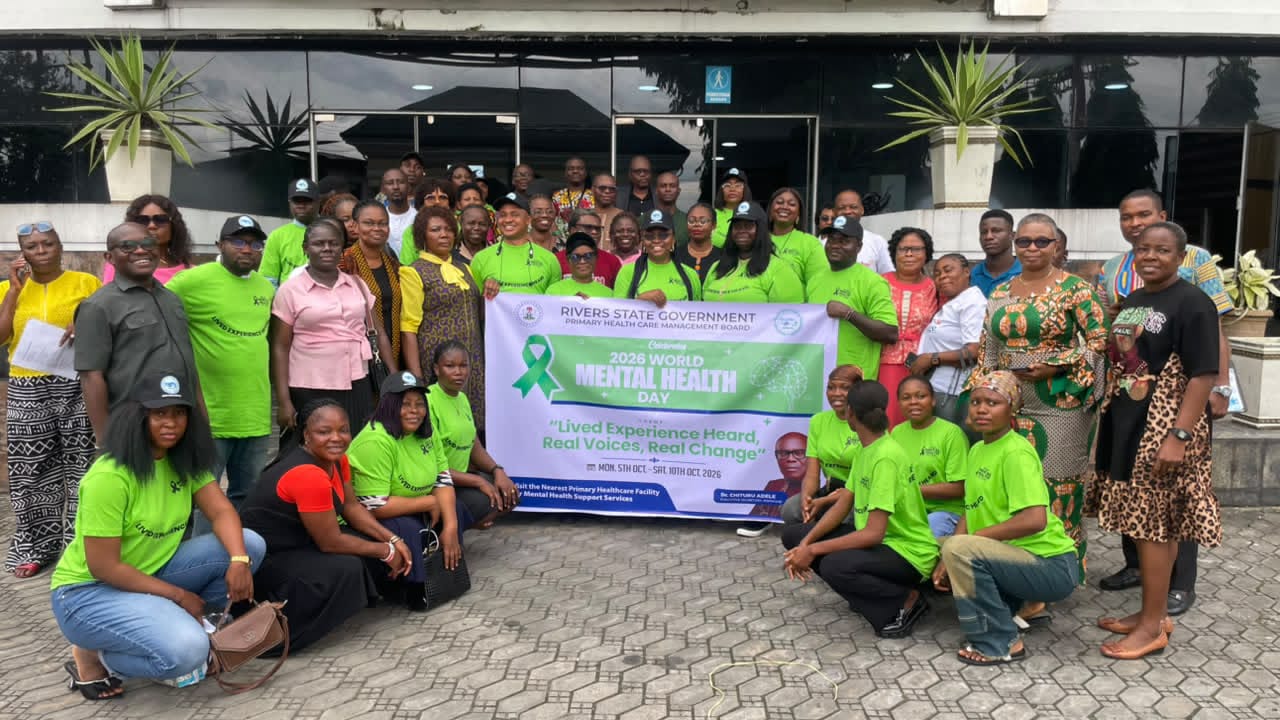
Speaking in Port Harcourt, Rivers State at the World Mental Health Day 2026, Dr Jack, who was represented by Dr. Pelle Aberetto, said the role includes identifying mental health concerns early, providing appropriate psychosocial support, reducing stigma, making timely referrals and ensuring continuity of care.
According to Dr. Jack, they must work towards a health system that ensures adequate care for emotional distress, anxiety, depression, psychological trauma, or any other mental health concern.
“This year’s theme, “Lived Experiences Heard: Real Voices, Real Change,” carries a powerful message. It reminds us that mental health is not merely a subject for policies, statistics, conferences and clinical discussions. Behind
every mental health challenge is a human being with a story, a family, a dream, a struggle and a voice that deserves to be heard”, he said.
Dr Jack further explained that many people experiencing mental health challenges have suffered silently due to stigma, discrimination, misunderstanding and fear of being judged.
He therefore emphasised the importance of listening, supporting and showing care and concern to individuals going through mental health issues.
“Today, we are reminded that listening is not simply an act of kindness; it is an essential component of effective health care.
When we listen to people with lived experience, we understand their challenges better: We identify barriers that may not be visible in our health facilities. We learn what works and what does not. Most importantly, we can design services that respond to the real needs of individuals, families and communities.
“As the Rivers State Primary Health Care Management Board, we recognise that
mental health cannot be separated from the broader health of our population.
Mental health intersects with maternal and child health, adolescent health, chronic diseases, substance use, gender-based violence, disability, infectious diseases, emergencies, family relationships and social wellbeing”, he said.
He therefore encouraged health workers to approach mental health with the samne seriousness, compassion and professionalism that they give to other areas of health care, emphasising on creating safe spaces where people can speak without fear of ridicule or
discrimination.
“Let us encourage individuals to seek help early.
Let us support families who care for persons experiencing mental health challenges. Let us challenge harmful myths and misconceptions.
Let us reject stigma, and let us ensure that mental health services become increasingly accessible through our primary health-care system”, he said.
He also called on communities, religious, traditional institutions, schools, civil society organisations and the media to become active partners in promoting mental wellbeing, adding that Mental health is everyone’s responsibility.
Speaking on “lived experience heard,
Subtittle : Power of lived experience”, the
Head of Mental health Desk, Nurse Ajoku Glory,
described mental health as a complete social, psychological and emotional state of every individual and not only absent of madness.
She warned that stigma can cause people to hide their experiences, or avoid seeking help, stressing that when people with lived experience are given safe opportunities to speak, they can challenge misconceptions such as the belief that mental health conditions are a sign of weakness, or that people experiencing them cannot contribute meaningfully to society.
She described “Lived experience” as the knowledge gained by a person through their own experience of a mental health condition, emotional distress, recovery, treatment, discrimination, caregiving, or supporting someone experiencing mental health challenges.
Nurse Glory further emphasised the need to create communities where seeking mental health support is seen as an appropriate step toward wellbeing, not something to be ashamed of.
“The person with lived experience should not be viewed only as a recipient of care. Their voice can also be a partner in improving mental health services and strengthening our communities”, she added.
Also, speaking of showing care to persons struggling with mental health issues, staying with them to ensure they are stable, Nurse Joy Olise, said mental health care service has been integrated into Primary Health Care which enables the public to assess mental health services through the Primary Health Care.
Nurse Olise therefore urged the public to show love, care and support to persons struggling with mental health issues, and not to judge them.
“They might be passing through depression and they will not tell you. They might be having anger issues. They might be having anxiety attacks, panic attacks. All you need to do is to listen to them. Don’t be judgmental”, she said.
The World Mental Health Day 2026 with the theme, “Lived Experiences Heard: Real Voices, Real Change” was set by the World Federation for Mental Health and supported by the World Health Organization.
This day provides the opportunity to elevate the voices of people with lived experience of mental health conditions to shape policies, dismantle stigma, and shift away from institutionalization toward community-centered care.