

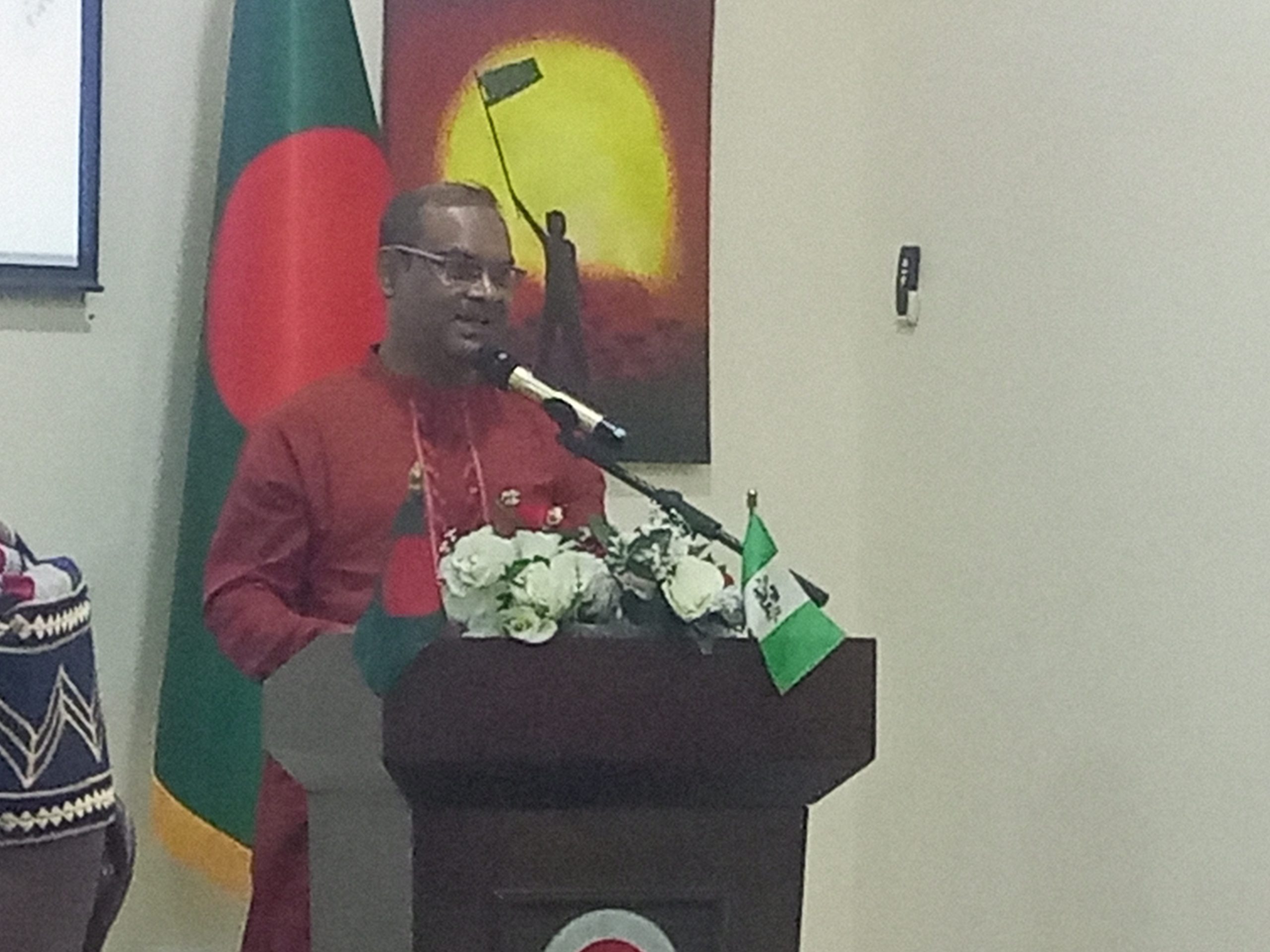
Bangladesh Embassy Holds Lalon Shah’s Day, Highlights Legacy To Deepen Cultural Ties With Nigeria
By Ferdinand Olise
The Bangladesh High Commissioner to Nigeria, Miah Kabir, has described the legacy of a renowned musician, Fakir Lalon Shah, as crucial in deepening unity, brotherliness, cultural ties, and peaceful co-existence between Bangladesh and Nigeria.
The High Commissioner stated this on Saturday in Abuja, at an occasion to observe the legacy of Fatir Lalon Shah, a Folk, Musician, Poet and Philosopher, believed to have lived from about 1774 to 1896 in Kushtia, Bangladesh. He noted that Lalon-Shah’s poetry is a mirror, a jewel of Bangla Culture, vividly reflected, noting that Lalon through his songs always campaigned against division of humanity based on caste, religion or practices.
According to him, Lalon challenged religious and caste divisions through folk songs performed in the everyday language of village communities.
Describing Lalon’s legacy and teachings on humanity, equality, love and unity, Mr. Kabir said
Lalon Shah’s poetry is a mirror, a jewel of Bangla Culture, vividly reflected. He further said that Lalon always campaigned that humans should not be divided based on caste, religion or practices, but believe in humanity and promote brotherhood and equality.
“Lalon Shah addressed himself mainly to simple, ordinary people. Lalon, was not targeting the urban elite, he was the poet of the ordinary people appealing to their human grandeur and divine dignity. The mystic poet – surpassing division caused by religion and society.
He said Lalon composed his poems in Bengal at a period marked by caste system and caste oppression.
“Lalon had experienced the pain of caste structure and knew the tactics of the elite.
Lalon developed a philosophy of a classless and casteless society Jatir utpati ko-thãe? he is asking (where is the origin of caste?) replying that there is no divine hand in the creation or establishment of a caste system.
Noting that Lalon is still present in the mind and heart of the people, the High Commissioner said Lalon’s songs are sung by the Bauls as well as by the association of devoted people.
“Lalon is called bauler raja, the King of the Bauls. Amidst dra-matic changes of the society, the Bauls, are still there and among them is Lalon in particular when they are gathering for several days at the yearly a get-togethers”, he said.
According to him, Lalon advocates secularism with devotion of the Divine and to respect the human being as divine and invites all religions to come together under the undivided One.
“Lalon’s philosophy challenges identity-based discrimination and highlights the importance of interfaith understanding and emphases on humanity. These speaks to Nigeria’s thought of peace and national cohesion.
“Lalon’s emphasis on self-knowledge has relevance for young people. In an age of social media, rapid communication and competing narratives, young people everywhere are exposed to messages that can either encourage understanding or reinforce prejudice.
“Lalon’s invitation to examine oneself before judging others is particularly relevant in this environment. It encourages critical reflection, intellectual humility and a willing-ness to question inherited assumptions. Lalon’s philosophy emphasises on the value of exchange and the power of music to connect people”, he said.
Noting that Nigeria is a country of extraordinary diversity, home to hundreds of ethnic groups, numerous languages and different religious traditions, Mr. Kabir said this diversity is one of Nigeria’s greatest cultural assets, but that managing diversity requires continuous efforts to promote mutual respect, social inclusion and peaceful coexistence.
“This is where Lalon Shah’s philosophy offers valuable food for thought.
Music is an important medium through which Nigerian communities preserve their histories, express their identities and communicate social experiences. Bangladesh’s Baul tradition, represented by Lalon Shah, offers a meaningful opportunity for cultural exchange with Nigeria, Both countries can explore how music conveys philosophical ideas, preserves cultural memory and brings people together across linguistic and geo-graphical boundaries”, Kabir said.
On his part, the Bangladesh Deputy High Commissioner to Nigeria, Faruk Hossain, said
the best tribute to Lalon is to practice what his song urges which is to listen before judging, adding that identities may describe people, but should never divide their humanity.
He said the best tribute to Lalon is to practice what his song urges which is to listen before judging, adding that identities may describe people, but should never divide their humanity.
” The best tribute to Lalon is not only to praise him, it is to practice what his songs asked of us; Let us listen before we judge. Let us question prejudice even when it is familiar. Let us protect our own belief without showing contempt for the beliefs of others. And let us remember one simple truth. Our identities may describe us, but they should never divide our humanity”, he said.
Meanwhile, the Dean of Faculty of Social Sciences, National Open University of Nigeria (NOUN), Prof. Kamal Bello, said Lalon’s ideology explained why he continued to be remembered long after his death. He added that Lalon’s philosophy of humanity rejected distinctions based on race, religion, class and political affiliation.
“This gathering is timely and useful to us in Nigeria because the legend stood for
an ideology. And the ideology he stood for is what he’s been remembered for after almost
20 centuries or two centuries after his death.
“He died almost 150 years ago and we still
remember him because of what he has done, not only in Bangladesh, but all over the world.
“One, he is a folk singer. It means that you can use song to change the society. He’s
a revolutionary because he made impact in life through music. He is a philosopher, he is a critical thinker. He represented his culture, he carried it, he practiced it”, he added.
Meanwhile, the Bangladesh Embassy said the programme aimed to deepen cultural ties between Nigeria and Bangladesh, and enable both countries to learn from each other.